
Migraine records
How to count your migraine days
“How many migraine days did you have last month?” It sounds like a simple question, but it is hard to answer from memory, especially after a month with long or back-to-back migraines. A running count is far less work than a full diary. This page explains how to keep one for three things: migraine days, headache days and days you took medication.
The three numbers worth keeping
- Migraine days: the number of calendar days on which you had a migraine, however long it lasted.
- Headache days: the number of days with a headache that you didn’t count as a migraine.
- Medication days: the number of days you took medication for a migraine or headache. Count days, not doses: two doses on the same day make one medication day. If you also want the number of doses, keep that as a separate number.
Some people, and some clinicians, count every day with any headache, including migraine days, as a headache day. Both ways are in use, so whichever you choose, say how you counted when you share the numbers.
Counting rules that keep the numbers clear
- A day counts once. Two migraines on the same day are one migraine day.
- A long migraine can cover several days. In this counter and in the app, a migraine that starts on Monday evening and ends on Wednesday morning counts on Monday, Tuesday and Wednesday. Some clinical and research definitions count overnight migraines differently, which is why rule 6 matters.
- A blank day is unknown, not migraine-free. If nothing was written down for a day, that day is missing, not a day without a migraine. It helps to say roughly how many days you are unsure about.
- Mark the day first. Details are optional. For a count, you only need to know which days were affected. Severity, symptoms and notes are useful, but a count still works without them.
- Pick one period and name it. “Last month” and “the last 30 days” give different numbers, so say which one you used.
- Write down how you counted. For example: “a migraine that ran past midnight counted on both days” or “headache days include migraine days”.
Migraine days and headache days are different numbers
You may be asked for either number, or both. For example, the International Classification of Headache Disorders (ICHD-3), which clinicians use to classify headache disorders, describes chronic migraine like this:
“Headache occurring on 15 or more days/month for more than 3 months, which, on at least 8 days/month, has the features of migraine headache.”
ICHD-3, 1.3 Chronic migraine, International Headache Society
The same section notes that describing frequent headaches “generally requires a headache diary to record information on pain and associated symptoms day-by-day for at least one month.”
Definitions like this are for clinicians making a diagnosis. A count on its own can’t tell you what kind of headache you have or what it means. If you are counting because your headaches are frequent or changing, bring your record to a doctor and ask them what it means for you.
Count a month
Choose what you are marking, then tap each day it applies to. Tap a marked day again to remove the mark. Nothing you enter is saved or sent anywhere, and reloading the page clears it.
A day is either a migraine day or a headache day. Medication is marked separately.
- Migraine days
- 0
- Headache days (not migraine)
- 0
- Days with a migraine or headache
- 0
- Medication days
- 0
The counter adds up the days you mark. It doesn’t interpret the numbers.
Keeping the count going
The best system is the one you will still use during a bad week. Any of these works:
- A paper calendar with one mark per day: M for a migraine, H for a headache, a dot for medication. Add them up at the end of the month.
- A note on your phone with just the date, and “M”, “H” or “meds” next to it.
- An app that saves the day for you, so the count is ready when you need it.
Whatever you use, record the day as soon as you reasonably can and leave the details for later. If a doctor has asked you to keep a diary, keep it for as long as they suggest. Preparing a summary for your appointment covers what to bring.
How Migraine Tracker counts for you
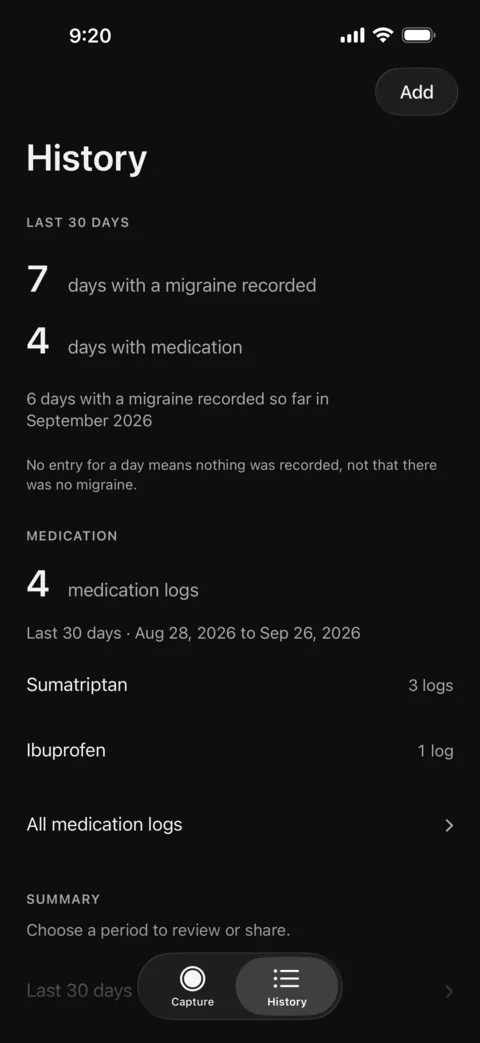
In Migraine Tracker: Capture, one tap saves the start of a migraine. When it is over, tap End migraine, or add the end time later. Any record can be marked as a headache instead.
History then shows, for the last 30 days, the days with a migraine recorded, headache days and days with medication. It uses the rules above: a day counts once, and a migraine that ran past midnight counts on each day it covered. A migraine with no end time is counted on its start day only.
The appointment summary repeats the counts, says how they were counted and lists what is missing. Medication entries are counted the same way, by day.
Let the count keep itself
Save a migraine in one tap, add details later if you want, and see your migraine days, headache days and medication days in History. Free on iPhone, with no account.
This page is about keeping records. It isn’t medical advice, and the counter doesn’t diagnose, interpret or assess anything. For questions about your headaches or your treatment, talk to a qualified healthcare professional.